
Darien Previous Residents by Era
No single source spans the whole life of a Darien address. Start with the row that matches the target period, then overlap at least two sources. A deed gives title evidence, while a directory or census may supply the household layer.
| Source | Years It Covers | Where Held | What It Shows |
|---|---|---|---|
| Recorder research | 1839-present; web images from 1961 | DuPage Recorder and IRAD | Deeds, liens, mortgages, plats, releases |
| DuPage directories | Cataloged from 1924 | FamilySearch and regional libraries | Name and address entries if a volume covers Darien |
| Downers Grove directories | Cataloged from 1927 | FamilySearch and DGPL | Regional household and street entries |
| Federal census | Released through 1950 | NARA, FamilySearch, libraries | Household, age, relation, birthplace, address |
| Local newspapers | 1971-2000 with gaps | IPPL microfilm | Obituaries, notices, civic and address clues |
| City records | Minutes 1994, resolutions 1997, ordinances 1998 onward | Darien Reference Desk and FOIA | Applicants, hearings, projects, named actions |
For recent decades, move from the assessor to the Recorder and permits. For older periods, the deed books still anchor the land, but regional directories, released census schedules, newspapers, cemetery records, and probate files are more likely to reveal past residents.
Three Darien Deed Cutoffs
The DuPage Recorder puts indexed documents and images online from March 16, 1961. PIN search begins in 1985. Property-address search begins in 1995. Those are different gates. An address failure before 1995 does not mean no deed exists, and a PIN failure before 1985 does not break the older title chain.
Use public terminals, deed books, and microfilm at 421 N County Farm Road in Wheaton for the earlier trail. Office research reaches back to DuPage County's organization in 1839. The research desk at 630-407-5401 handles certified-copy questions. No current official copy-price schedule was captured, so confirm the charge before ordering.
Note: Treat an online cutoff as an access boundary, not as the start of a property's recorded history.
Trace Darien Owners Backward
Start with the DuPage Property Lookup. Copy the current PIN, owner display, situs address, legal description, and transfer details. Then open the Recorder search. A recorded instrument is evidence that a document was filed, not proof that the named person lived at the property.
- Open the current assessor card and save the PIN and legal description. Keep the site address separate from the tax mailing address.
- Find the current purchase deed by PIN, address, or grantee name. Record the instrument number, date, parties, and prior reference.
- Search the seller as a former grantee. Confirm the same lot, subdivision, and legal description.
- Repeat the loop. Distinguish a deed from a mortgage, release, lien, trust paper, or transfer-on-death instrument.
- When web coverage ends, take the last sound reference to the Recorder's terminal, older book, or microfilm.
- Grantor / grantee
- The grantor transfers an interest; the grantee receives it.
- Chain of title
- The linked sequence of recorded transfers for the same land.
- Legal description
- The formal lot or land wording that can survive a change in street label.
Keep Darien Land Identity Stable
Darien's older geography does not always use the modern city name. Before incorporation on December 13, 1969, records may say Marion Hills, Brookhaven, Clairfield, Hinsbrook, Lace, Cass, Downers Grove Township, or a subdivision. Preserve each label rather than silently changing it to Darien.
No official source established a citywide Darien street-renumbering year. If the street text shifts, compare the subdivision, lot, legal description, plat, neighboring owners, and PIN history. A PIN can also change after a parcel split or combination, so the legal description and recorded plat remain vital checks.
Darien Previous Residents in News
The Indian Prairie Public Library local-history shelf offers photographs, partner history resources, and area newspaper microfilm. Its ScanPro 1100 makes the reels usable at the library. The listed Progress-family coverage spans 1971 through 2000 with gaps. A missing run is not proof that no event occurred.
The library's source page shows the entry point used to extend a deed timeline. Review IPPL's local-history source before a visit.
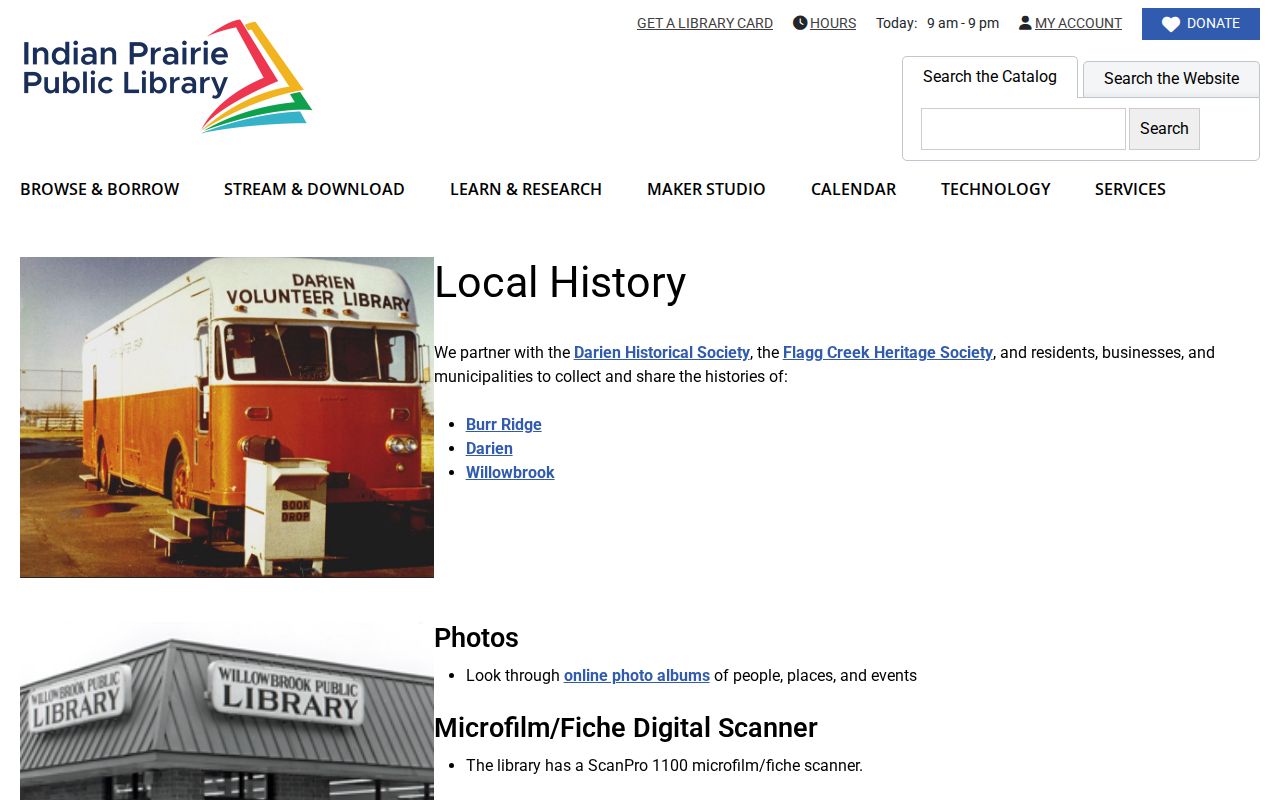
The captured page connects Darien researchers with newspapers, images, and local partners that can place a past resident in time.
Marion Hills Civic Association formed in 1949, and its mimeographed Village News ran from 1950 through 1958. Search Marion Hills and related community names, not just Darien, for people there before incorporation.
Date a Darien House Carefully
Permits can add a project date, applicant, contractor, plans, and inspection events. Darien says structural, plumbing, and electrical work generally triggers permits, while some roof, siding, soffit, and fascia work does not. The current OpenGov start date and full historical coverage were not exposed. Use the portal first, then request public material through Darien FOIA.
The Library of Congress has a 1927, 16-sheet Downers Grove Sanborn fire-insurance map. No official Darien-specific edition was found, so it is only a regional lead. Never claim that a sheet depicts a Darien parcel until its coverage and street labels have been checked. No public customer-level utility register was located.
Castle Eden's Darien Trail
Castle Eden offers a single-property example rather than a model for every Darien house. Built in 1903 as a one-tenth-scale White House replica on former Elisha Smart farm land, it links the Smart and Madden families, the Cass area, photographs, land records, newspapers, and city files. A July 2026 demolition notice adds a current permit and council-record layer.
Build that kind of trail from citations, not lore alone. Compare the deed and legal description with dated photos, newspaper text, permit papers, and official meeting records. The same method can test other notable Darien properties without assuming every remembered name was an owner or resident.
Close a Darien Resident Trail
An obituary can connect a former Darien resident with relatives, a former address, church, cemetery, or date of death. Downers Grove Public Library's obituary index covers most years from 1895 to the present, while IPPL's local film supplies a more focused Darien-area route for its available years. Search spelling variants and the older community names found in the deed timeline.
Next, check the DuPage Circuit Clerk's probate or estate files. A docket is the dated list of filings and court events in a case. An executor, heir, or estate deed may explain a later transfer, but the court result and Recorder instrument should be compared before joining them. Browser access can face CAPTCHA or availability limits. Public courthouse terminals and copy requests remain the fallback for accessible files, while sealed or impounded material stays unavailable.
Confirm Darien Previous Residents
Ownership is only half the question. A criss-cross directory arranges entries by address, while a standard directory is often arranged by name. Regional DuPage directories are cataloged from 1924 and Downers Grove directories from 1927, but exact Darien pages and years need volume-level confirmation. The Darien city directory page covers those collections.
Pair a directory entry with a released federal census. The 1930, 1940, and 1950 schedules can show a household, relations, ages, birthplaces, and an address or enumeration district. An enumeration district is the area assigned to a census taker.
- Choose the directory year nearest a released census and copy the entry exactly.
- Find the census enumeration district for that place and street.
- Compare name, address, age, relation, birthplace, and nearby households.
- Repeat in the next directory or census year, noting moves and spelling changes.
For the end of a trail, use IPPL or the Downers Grove obituary index. Then check DuPage probate files for an executor, heir, or estate transfer. A same-name match is not enough; dates, relatives, address, and deed must agree.
Lawful use. Research Darien previous residents for house history, genealogy, estate work, or personal curiosity. Never use a record trail to track, harass, or harm a living person.